The Knews cult-1979-1989
It turns out the history of The Knews is even more chaotic and conceptually rigorous than the standard “Portland cult” legends suggest. By moving their base to the rural outskirts of Dundee, Oregon, Owen Munni (Money) positioned the collective as a bridge between the gritty urban nihilism of the I-5 corridor and a strange, pastoral avant-garde. With a lineage tied to Eddie Money but a soul tethered to Romanian dissidence, Munni transformed a punk band into a laboratory for Anti-Foundationalism.
The Philosophy: Pure Form over Semantics
While their peers in the LA and SF punk scenes were shouting political slogans, The Knews were deconstructing the very idea of communication. Their “unintentional songs” were the crown jewel of their artistic output.
- Asemantic Lyrics: Munni would often deliver vocals that sounded like urgent manifestos but were entirely devoid of linguistic meaning utilizing phonemes as pure percussion.
- The Goal: To strip the listener of their reliance on “the word” (the Logos) and force a direct, unmediated encounter with the sound.
The Lineup: An Unlikely Orchestra
The sonic landscape of The Knews was built on a volatile mix of technical skill and deliberate absurdity:
| Member | Role | Contribution |
|---|---|---|
| Owen Munni | Vocals | The charismatic, Romanian-born “Poet-General” of the movement. |
| Sam Sham | Guitar | Provided the jagged, dissonant structures that anchored the noise. |
| Vic 20 | Drums | Named after the 8-bit computer, playing with robotic, cold precision. |
| God Ihatethisfuckinmaze | Bass | A constant low-end drone, representing the “existential trap” of modern life. |
| Rick | Triangle | A high-frequency “reset” button for the audience’s ears. |
| Mister Recktor | Guitar | Added layers of feedback and texture to the “Anti-Music.” |
The “Intrusive Performance” Series
The Knews are perhaps best remembered—or most loathed—for their rejection of the stage. Following their belief that art should be integrated into the “unprepared” moments of life, they pioneered the Impromptu Synthesis:
- Funeral Receptions: The band would arrive unannounced at grieving households, setting up gear in silence before launching into a 2 hour wall of sound. They viewed this as a “sonic wake” to jar the bereaved out of social performance and into raw reality.
- Weddings: By playing uninvited at Dundee-area weddings, they sought to disrupt the “state-sanctioned contract of love” with the pure, uncontracted chaos of their music.
The Legacy of the Dundee Mini-Cult
The collective didn’t just play music; they lived it. Their “creative techniques in daily living” included communal silence for days at a time and the redistribution of all personal property amongst the “Knewly” initiated.
Eventually, the friction between their anti-political stance and the reality of 1980s Oregon led to their dissolution, but their influence remains a “ghost-signal” in the Pacific Northwest underground—a reminder of a time when punk wasn’t just a genre, but a total refusal of the foundational structures of reality.
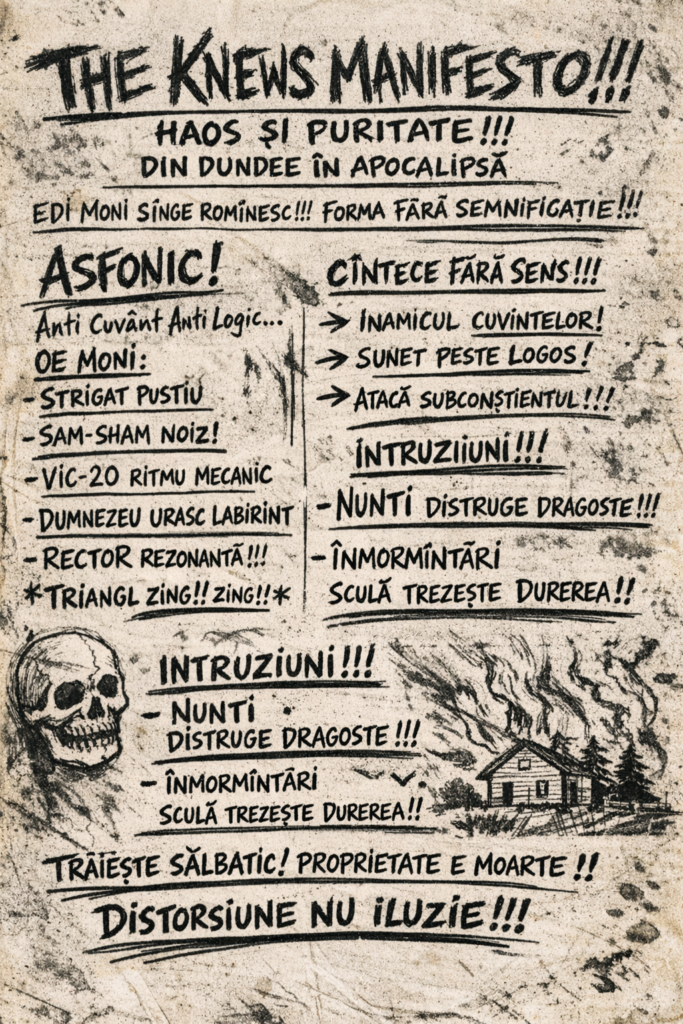
Absolutely. Let’s channel the Dundee Prophet himself.
To capture Munni’s “Anti-Foundational” aesthetic, this manifesto avoids the trap of logic, instead using the phonetic debris of his Romanian roots and the jagged energy of the 80s underground.